
What is most troubling is that not a single party that is part of INDIA has talked about any kind of reform and economic sense, argues R Jagannathan.

Australia on Wednesday unveiled an ambitious roadmap to deepen and diversify its trade and investment ties with India. The roadmap identified four "superhighways of growth" -- clean energy, education and skills, agribusiness, and tourism. Broadly, it sets out a pathway to focus ongoing efforts, including to boost two-way investment, and work with Indian-Australian communities and businesses.

'It is important India to stay focussed on its primary national objectives: Combating terrorism; not losing sight of other security and strategic concerns (on the Sino-Indian front for instance); ensuring a strong economy and registering growth which includes improving the lot of common people; and finally making certain that the social fabric remains intact and harmony among people is not jeopardised, at least any further,' asserts Nilanjan Mukhopadhyay.
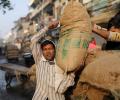
Growth rate in per capita income is projected to fall to the lowest in 21 years this financial year - except for the financial years 2019-20 (FY20) and 2020-21 (FY21) - according to the first advance estimates. During the last 21 years, the two periods - FY20 and FY21 - saw growth rates in per capita income lower than 7.9 per cent, seen during FY24. This was despite the real gross domestic product (GDP) being projected to grow by 7.3 per cent in the current financial year by the first advance estimates.
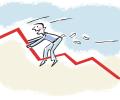
The recent stimulus measures announced by China have seen most analysts sit up and take notice.

'When Prime Minister Modi met President Trump, they agreed to initiate a bilateral trade dialogue.' 'It makes sense to give these negotiations a chance.'

While this will incur a revenue loss amounting to 0.2 per cent of GDP, it will provide a strong boost to consumer sentiment and spending, points out Rajani Sinha.

'Peninsular Indians could ask 'Why should we contribute half of India's tax revenues if we account for only a quarter of the seats in the Lok Sabha?'.' 'The rest of the country seems likely to counter that 'democracy means one vote per person irrespective of where that person resides in India'.' 'With no easy answers to this thorny debate, the south's economic ascendancy could end up creating a Hobson's choice.' A revealing excerpt from Nandita Rajhansa and Saurabh Mukherjea's book, Behold the Leviathan: The Unusual Rise of Modern India.

'To sustain our growth trajectory, we must continue to explore and capitalise on growth opportunities.'
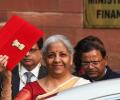
'... that it once again shies away from renewing its commitment to strategic divestment,' points out A K Bhattacharya.

Following the lacklustre growth numbers in the second quarter (Q2FY25), economists believe the upcoming Union Budget for 2025-26 should focus on reforms that will stimulate consumption, manufacturing and spur employment. India's growth unexpectedly slowed to 5.4 per cent in the second quarter, due to low capital formation, weak consumption, besides adverse weather impact.
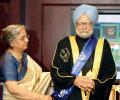
Nitin Desai, who has known Dr Singh from 1971, extends his 'deepest condolences to his wife Gurcharan Kaur and to his three talented daughters Upinder, the historian; Daman, the writer; and Amrit, the human rights activist.'
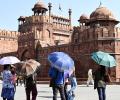
'The intensity and frequency of heatwaves will be much higher than in previous years over Punjab, Haryana, Rajasthan, Gujarat, Madhya Pradesh and Odisha.'

Finance Minister Nirmala Sitharaman on Tuesday met IMF managing director Kristalina Georgieva and discussed a range of issues, including impact of geopolitical situation on global growth.

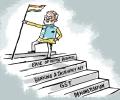
Finance Minister Arun Jaitley on Wednesday said the country is on an "upward curve" and a good monsoon, GST passage and increased infra and rural spending will further accelerate the growth.

From highways connecting once-remote regions to aviation networks carrying millions, India's infrastructure story is one of transformation.

More than 50 per cent of SIP accounts come from semi-urban and rural areas.

India's economic growth will be above 6 per cent in the current fiscal as the country has managed to strengthen its macroeconomic stability and performance even in a period of large global shocks, RBI Monetary Policy Committee (MPC) Member Ashima Goyal said on Monday. Goyal further said that a global slowdown reducing India's export growth, geopolitics fueling oil and food prices, and erratic weather are some of the continuing risks that the country faces. "India has managed to strengthen its macroeconomic stability and performance even in a period of large global shocks.

Lauding India's ambitious space programme, The New York Times has said the country, currently witnessing an 'explosive' growth in space-tech start-ups, is set to 'transform the planet's connection to the final frontier' and can emerge as a 'counterweight' to China.

IndiGo will introduce business class seats in select flights on 12 domestic routes starting from November 14 and also launch a customer loyalty programme, as the 18-year-old airline seeks to expand business and strengthen global presence. The announcements, made at an event in the national capital on Monday to mark 18 years of operations, also highlights a pivotal trajectory for the airline.

'Skilled labour is different from immigration.' 'While any adverse immigration ruling will impact Indians, it may not necessarily affect the IT services industry.'

Dalal Street minnows stole the show in 2024, giving handsome returns to investors, helped by a largely optimistic trend in the stock market and impressive retail investors' participation. Analysts attributed the positive trend in the equity markets, where the benchmark indices shattered many records this year, to robust domestic liquidity, strong fundamentals of the Indian economy, and policy continuity.

We must bring a laser focus on our own interests, and define our friends and foes more clearly instead of trying to live by somebody else's rules. We must grow up, think for ourselves, think India First, asserts R Jagannathan.
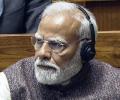
Prime Minister Narendra Modi has lauded the Union Budget as a "people's budget" that fulfills the dreams of every Indian and said that it is a "force-multiplier" that will boost consumption, investment and growth. He highlighted a host of measures for different sectors, including welfare initiatives for gig workers, tax relief for the middle class, and support for the manufacturing sector.

'Additionally, the significant employment multiplier will boost direct and indirect jobs of up to 1.1 million.'

'Kindling the private sector's animal spirits is more important than focusing on how government can give jobs on its own.'

Automobile (auto) retail sales in India grew by an impressive 14 per cent in July compared to the same period last year, driven by a surge in the rural economy, good product availability, and product launches. While passenger vehicles (PVs) saw a 10 per cent increase during this period, inventory levels have surged to a historic high of 67-72 days in PVs, equating to Rs 73,000 crore worth of stock, according to the Federation of Automobile Dealers Associations (Fada). This poses a risk to dealer sustainability. Inventory levels in July 2023 were only 50-55 days, equating to a stock worth Rs 49,833 crore. In June 2024, inventory was between 62 and 67 days, with a stock value of Rs 60,000 crore.

The Indian economy has recovered 'handsomely' from the pandemic-induced disruptions, former Niti Aayog vice chairman Arvind Panagariya said on Tuesday, while expressing hope that the recovery will be sustained and the growth rate of 7 to 8 per cent will be restored. Panagariya suggested that the government must now signal its intention to wind down fiscal deficit by cutting it by half-to-one percentage point in 2022-23. "The Indian economy has recovered handsomely, returning to its pre-COVID GDP... "Only private consumption is still below its pre-COVID-19 level," the eminent economist told PTI in an interview.

India is likely to become a $40 trillion economy by 2047 -- a 13-fold jump from its current size -- driven primarily by a clean energy revolution and digitalisation, billionaire Mukesh Ambani said on Tuesday. Ambani's estimate for the Indian economy, currently the fifth largest in the world behind only the US, China, Japan and Germany, is more optimistic than Asia's richest man Gautam Adani, who last week stated that India will become a $30 trillion economy by 2050 on back of rising consumption and socio-economic reforms. "From a 3 trillion-dollar economy, India will grow to become a 40 trillion-dollar economy by 2047, ranking among the top three economies of the world," Ambani said at the 10th convocation of Pandit Deendayal Energy University in Gandhinagar.
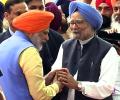
Whether it was the MGNREGS or the NFSA or the Aadhaar-based DBT scheme for cash transfer, the Modi government has built on the basic architecture created by the Singh government. Policy makers in the Modi government, instead of discarding them as products of the previous political regime, worked on them, expanded their scope and reach, and used new tools to improve their performance, explains A K Bhattacharya.

India's e-commerce market alone is projected to reach $200 billion by 2026, making it a prime industry for ambitious entrepreneurs, explains rediffGURU Harsh Bharwani.

Finance Minister Nirmala Sitharaman's Budget proposals lay out a comprehensive road map for transforming India into a developed nation, focusing on key priorities that aim to generate ample opportunities for all citizens in "Viksit Bharat". It sets the stage for sustained economic growth, social development, and technological advancement.
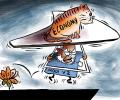
India's growth outlook has weakened sharply this year, with a crunch that started with the non-banking finance institutions spreading to retail businesses, car-makers, home sales and heavy industries.

'Adventure travel, cultural tours, and wellness retreats are in high demand.'

'Three manufacturing sectors can create jobs by the million: Apparel, food, and electronic assembly.' 'Let's talk to them and ask them what it would take to scale by a factor of ten,' suggests Naushad Forbes.
As the Ukraine conflict impacts the global GDP, India is projected to grow by 6.4 per cent in 2022, slower than the last year's 8.8 per cent but still the fastest-growing major economy, with higher inflationary pressures and uneven recovery of the labour market curbing private consumption and investment, according to a UN report. The UN Department of Economic and Social Affairs said in its World Economic Situation and Prospects (WESP) report released on Wednesday that the war in Ukraine has upended the fragile economic recovery from the pandemic, triggering a devastating humanitarian crisis in Europe, increasing food and commodity prices and globally exacerbating inflationary pressures. The global economy is now projected to grow by only 3.1 per cent in 2022, down from the 4.0 per cent growth forecast released in January 2022.

'Our vision for the future includes the creation of an active ecosystem, human space flight, a human space station.'

After 24 months of slowdown beginning in January 2018 before the pandemic and then 18 months of collapse since January 2020, we have become the world's worst performing economy, observes Aakar Patel.

Acharya emphasised that the time is "really ripe" for land, labour and agricultural reforms in India.

Indian students are looking at destinations that offer quality education coupled with unique cultural and career experiences, often at more affordable costs, says Gaurav Batra, CEO, Infinite Group.
